Your career has evolved. Has your resume kept up?
Your resume may be telling an old version of your story.
Senior executives often come to us with a resume that is technically accurate but strategically wrong. It lists their jobs, describes their responsibilities and documents where they have worked, but it does not explain the value they bring.
As careers become more senior, that distinction matters. Your resume needs to communicate leadership impact, commercial contribution, career achievements, scale, complexity and the problems you know how to solve. It needs to make sense to recruiters and executive search consultants. It needs to support your LinkedIn positioning. Increasingly, it also needs to be structured so recruitment technology can interpret it effectively.
A professional resume writer should do more than make your existing document sound better. They should help you work out what your career story actually is.
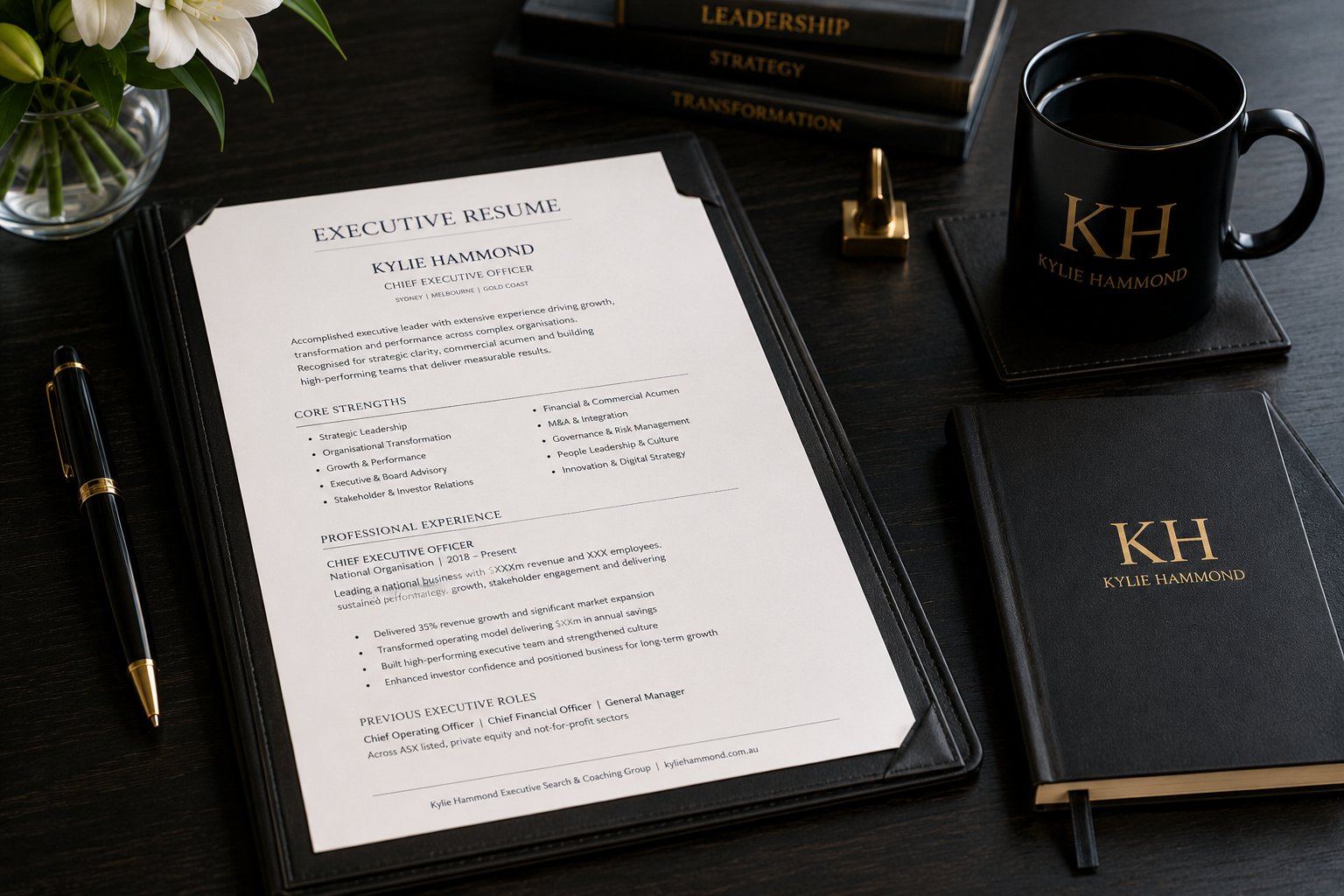
The central question is not whether you have a resume. It is whether the document still represents you at the level you now operate — and whether it is helping or hurting the next move.
That question tends to arrive at a turning point:
If the document was last rebuilt for a role you have already outgrown, it will keep introducing the previous version of you. The work is to test that, honestly, before you spend money rewriting it.
Read your current resume as a recruiter or executive search consultant would. Answer Yes, No or Unsure. Yes scores 1, Unsure scores 0.5, No scores 0. The running total updates as you go.
If you do not have a current resume, still work through the questions. They will tell you what the next document needs to do.
Group
1. Is it immediately clear what level of executive you are?
2. Does your opening profile communicate a genuine value proposition?
3. Can someone understand your key areas of expertise within 20–30 seconds?
4. Is the resume positioned towards where you want to go, not simply where you have been?
Group
5. Does it show what changed because of your leadership?
6. Are achievements supported by evidence, numbers or meaningful outcomes?
7. Does it communicate scale: revenue, budgets, teams, operations, markets or customers?
8. Does it distinguish achievements from normal job responsibilities?
Group
9. Does it demonstrate leadership complexity?
10. Does it show your interaction with CEOs, boards, investors or other senior stakeholders where relevant?
11. Does it demonstrate commercial judgement rather than only technical expertise?
12. Does the language sound appropriately senior without becoming inflated or full of jargon?
Group
13. Is the document structured so an ATS can interpret it?
14. Does it contain the terminology recruiters are likely to search for?
15. Are important capabilities visible rather than buried deep in the document?
16. Is it free of unnecessary design elements that could compromise machine readability?
Group
17. Does your resume align with your LinkedIn profile?
18. Is it relevant to the roles you are currently targeting?
19. Would an executive search consultant understand where to position you?
20. Most importantly: is it getting you interviews for the calibre of roles you actually want?
Answer the points above to see your score.
There are 20 questions across five groups: positioning, achievement, executive credibility, recruitment technology and market alignment.
Not sure how objectively you scored yourself? Send us the document and we’ll take a look.
Being good at the job does not automatically make you good at writing about it. Senior executives are often too close to the material. After ten, twenty or thirty years, achievements that would impress an external reader can feel ordinary to the person who delivered them.
The resume then reads like a job description with a senior title on top. Internally, everyone already knows what you did. Externally, nobody does — unless the document makes it visible.
The job of a good executive resume writer is partly to recognise the value the executive has stopped noticing.
A senior resume is not a complete career archive. It has three jobs, and it has to do all three.
01
The right terminology, capabilities, titles and keywords need to be present so recruiters and recruitment systems can identify relevance.
02
Someone should quickly understand who you are, what level you operate at, what you are particularly good at, and the sort of organisation or challenge you suit.
03
The resume does not need to tell the reader everything. It needs to give them enough evidence to think: I should meet this person.
For many advertised roles, a resume now enters an Applicant Tracking System before a recruiter or hiring manager sees it. Those systems parse career history, titles, skills, qualifications and keywords. Some processes also use AI-assisted matching or screening. That is a structural fact of modern recruitment. It is not a reason to write for machines and forget people.
What has changed is the architecture of the document. Conventional headings, a logical order, readable fonts and terminology that matches how roles are actually described all help a system interpret the file. Unusual tables, text locked inside images, and decorative layouts that look clever in print can make the same content harder to parse.
Clear headings, logical structure and machine-readable formatting, so the file can be interpreted rather than discarded as noise.
Language should reflect the roles, capabilities and markets you are targeting — the words search consultants and hiring managers actually use.
Keywords alone are not enough. The resume must show how those capabilities have been applied, at what scale, and with what result.
A person still needs to believe the executive is worth meeting. Technical compatibility is useless if the story is thin.
The aim is not to “beat the ATS”. The aim is to build documentation that can travel effectively through a modern recruitment process.
Search-led and board appointments often still start with a conversation. Advertised roles may not. The document has to work on both paths. We do not claim that any wording can force a system to rank you first, and we do not treat ATS as a gimmick. It is one part of how senior people are now assessed.
Senior candidates need positioning, not mass applications. A resume targeting a COO role should not necessarily be framed identically to one targeting CEO. A CEO resume should not simply be sent unchanged for a Non-Executive Director opportunity.
The underlying career history remains true. The lens changes.
Make transferable evidence obvious, and stop leading with sector jargon the new market does not use.
Shift from functional mastery to enterprise contribution, stakeholders and commercial judgement.
Show P&L altitude, board interaction, and the problems you can own as the most senior executive.
Separate the operating story from advisory, interim and board strands so the reader can place you.
Rewrite for governance, oversight and judgement. Do not paste “Board Director” onto an executive CV.
Carry a clean forward argument. The document should not read as a defence of the last chapter.
A low-cost formatting exercise can make a weak document look tidier. It cannot decide what the document is arguing. Professional executive resume writing is a strategic exercise, not a cosmetic one.
What have you actually done — as opposed to the internal title you were given?
What changed because you were there?
What problems can you solve for another organisation?
What opportunities are you targeting, and who is assessing you?
How should an executive search consultant describe you to a client?
What numbers, outcomes, scale and achievements support the claims?
Do your resume, LinkedIn and biography reinforce rather than contradict one another?
The documentation should be informed by executive search, board market knowledge, career strategy and personal branding — not written in isolation from how senior people are actually assessed and hired.
Use this as a routing guide, not a catalogue. If two statements are true, start with the complimentary assessment and we will point you to the right brief.
My resume is outdated
For executives who need their core career document rebuilt and repositioned for the level they now operate at.
My resume and LinkedIn do not match
A coordinated rebuild so the executive brand is consistent across applications and online search.
I am CEO / C-suite / very senior
For senior leaders who need enterprise leadership, commercial impact, transformation and governance positioning.
I am pursuing board roles
A board-specific document focused on governance, strategic oversight, risk, judgement and board contribution.
I need my professional story condensed
For websites, board packs, speaking engagements, advisory roles, investor materials and introductions.
I do not know what I need
Send the current material and a target role. We will review it and direct you to the right service — or tell you if the document is already doing the job.
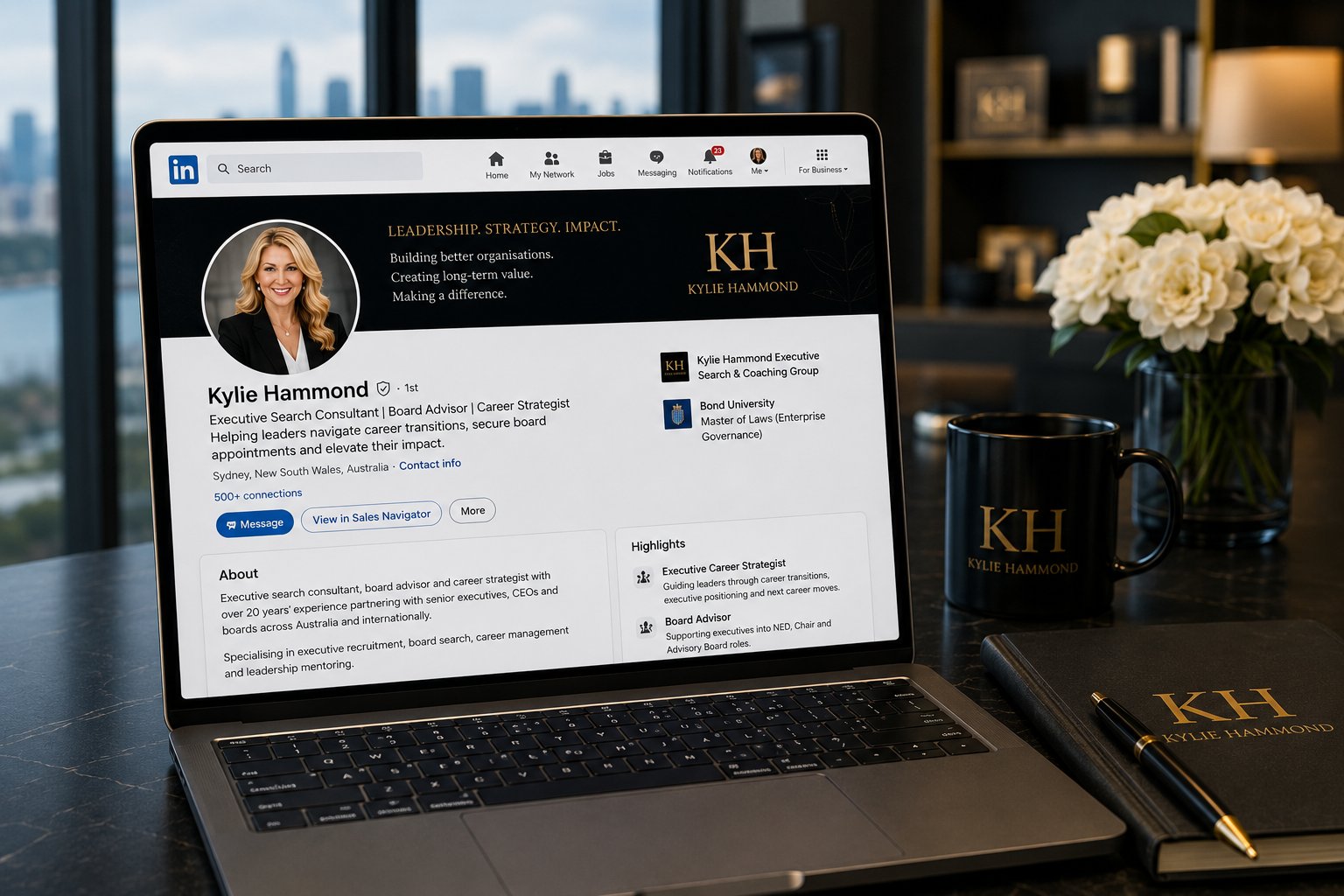
At senior level, people will look you up. Your resume may introduce you. LinkedIn may validate you. A corporate biography may introduce you to a board, conference, investor, client or professional network. An executive search consultant may compare all three.
The positioning should not be identical. It should be consistent.
Depth and evidence. The formal argument for a specific type of opportunity.
Visibility, searchability and market presence. The version most people will find first. See LinkedIn profile development.
A concise professional proposition for packs, sites and introductions — not a third, conflicting story.
If the three assets disagree about your level, sector or next move, the reader will believe the weakest version. For a fuller documentation set, see the Career Portfolio.
Do not take an executive resume and put “Board Director” at the top. The reader is assessing a different proposition. Chairs and nomination committees are not hiring you to run the business day to day. They are weighing judgement, oversight and the value you add in the room.
If board work is the destination, start with a board resume, then the wider pathway: Board Portfolio®, the Board Portfolio® Blueprint, and Tiger Boards.
Different career stages require different positioning. The common denominator is that the documentation needs to accurately reflect the level at which you operate and the value you bring.
Not because of generic claims about great writers. Because senior documentation has to be written with an understanding of how senior people are actually assessed.

Understanding how senior candidates are read by search consultants, CEOs and Chairs.
Documentation aligned to the next move, not a polished record of the last one.
Board positioning is different from executive positioning. The documents should be too.
Converting complex careers into concise, commercially credible narratives.
Aligning resume, LinkedIn and biography so they support the same proposition.
Executives, CEOs, board directors and Chairs — in Australia and internationally.

Meet Kylie
Kylie Hammond LLM Ent Gov has spent more than two decades at the intersection of executive search, executive careers, leadership positioning and board appointments. A senior resume should not be written in isolation from that market.
The work is confidential and one-to-one. If the right next step is mentoring, interview preparation or a board pathway rather than a rewrite, that is what we will say.
Before you spend money rewriting your resume, find out whether it actually needs rewriting.
Ask us to look at your current resume, your LinkedIn URL, and a position description or example role you are targeting. A current cover letter is useful if you have one.
We review the material from the perspective of executive positioning, presentation, achievements, market alignment and the overall career narrative. You then know whether the document needs a rebuild, a reposition, a LinkedIn alignment, a board-specific version — or whether it is already fit for the move you want.
It is worth it when the document is no longer representing the level at which you operate, or when you are too close to the material to see what is missing. A professional writer who understands executive search can recover achievements you have stopped noticing, reposition the story for the next market, and make the file usable in a modern recruitment process. It is not worth it if you only want a prettier layout of the same operational CV. Start with the health check or a complimentary assessment if you are unsure.
The useful work is not typing. It is establishing the career story, extracting evidence, deciding the argument for a target market, and writing a document that a recruiter, search consultant, CEO or Chair can place in seconds. That includes structure, language, ATS-aware formatting and alignment with LinkedIn and, where needed, a biography. If the writer only formats what you already sent, you have bought a design job.
There is no single figure that fits every brief. Cost depends on seniority, how many documents you need, and how much positioning work sits behind the writing. We do not publish a one-size fee on this page. Request a complimentary resume assessment and look at current packages in the online shop.
Long enough to evidence seniority, short enough to be read. For most senior executives that is two pages; some CEO, board or international briefs run to three. Length is not a virtue. If a third page exists only because nothing was cut, cut it. Clarity of level, scale and outcomes matters more than page count.
Yes, if you will apply through advertised processes that use an Applicant Tracking System. That means conventional headings, a logical hierarchy, readable fonts and terminology the market actually uses. It does not mean stuffing keywords, and it does not replace the need for a human being to want to meet you. Board and search-led work often starts with a conversation; the document still has to travel if it is later uploaded.
Look at the file, not the design. Can the content be copied as text? Are headings standard (Professional Experience, Education, not inventive labels)? Is important information sitting in images, text boxes or complex tables? Does the language match the roles you want? If you are unsure, that is one of the things a complimentary assessment is for. We will not pretend a score from a free online scanner is a verdict on your career.
Some advertised processes use AI-assisted screening or matching before a person reads the file. A system can deprioritise a document it cannot parse, or one that does not appear relevant to the brief. That is not the same as a mysterious algorithm rejecting you forever. Structure, relevance and evidence still matter. So does the version of you that appears on LinkedIn when a person looks you up afterwards.
You should not fire the same argument at every brief. A COO frame, a CEO frame and a board frame are different because the reader is assessing different things. The core evidence can be shared. The emphasis should not be identical. Tailoring at this level is positioning, not rewriting your entire history each Sunday night.
Often the resume is introducing the wrong version of you: too operational, too dated, too generic, or aimed at a market you have already left. Sometimes the document is fine and the channel is wrong — advertised volume instead of search, or a LinkedIn profile that contradicts the file. Sometimes the target role is unclear. The health check and a complimentary assessment are designed to separate those problems before you commission a rewrite.
Enterprise altitude: the size and complexity of what you led, commercial outcomes, transformation or turnaround, capital and stakeholder work, board interaction, and the problems you are now equipped to own as the most senior executive. A CEO resume is not a longer general-manager CV. If you are stepping up to CEO, the document has to make that step obvious. See CEO and C-suite resume writing.
An executive resume argues for an operating mandate. A board resume argues for governance contribution: oversight, judgement, risk, financial literacy, committee work and independence. Adding the word “governance” to an executive CV is not a board resume. If you want both markets, you usually need both documents. See the board resume and Board Portfolio®.
If LinkedIn still describes a job you left years ago, undersells your level, or tells a different story from the resume, then yes. Search consultants and Chairs will look you up. The profile is often the first version of you they believe. A combination brief is usually the cleanest way to align both. See Resume and LinkedIn combination or LinkedIn profile development.
It should tell the same story, not paste the same paragraphs. The resume carries depth and evidence. LinkedIn carries visibility, searchability and a shorter professional narrative. If the two disagree about title, scope or direction, the inconsistency becomes the story.
A short professional narrative used in board packs, websites, speaking materials, investor documents and introductions. It is not a compressed resume and it is not marketing copy. It should match the resume and LinkedIn, not invent a third persona. See corporate biography writing.
Yes. Industry moves need the transferable evidence made obvious and the old sector jargon retired. After redundancy, the document has to carry a clean forward argument rather than a defence of the past. If the next move itself is unclear, executive career mentoring may sit in front of the writing. For employer-sponsored exits see executive outplacement.
Yes. The work is delivered nationally and internationally, usually by video. Documentation is written for the market you are targeting, not for a single domestic template.
Take the health check, or send the current resume in. Either way, you will know what the next step actually is.