Senior careers rarely move in a straight line. A role changes. A CEO leaves. A restructure lands. You are overlooked for a promotion. You have been in the same organisation for ten years and suddenly realise the market has changed while you have been busy doing the job.
At executive level, good career management is not about sending more applications. It is about reading the market properly, being clear about the value you bring, putting the right career assets around that story, and building relationships with the people who can actually open the next door.
This guide brings together the practical advice I give executives every week: how to think about the next move, how to position yourself, how to run a senior-level search, how to prepare for interviews, and when it may be time to think beyond another full-time executive role.

If you are not sure what your next move should be, start with the diagnosis. You do not need a perfect five-year plan. You do need to know what problem you are trying to solve.
Choose your situation
Before rewriting a résumé or calling a recruiter, get clear on the decision in front of you. Executives often jump straight into job-search activity because doing something feels better than sitting with the bigger question.
Your next move may be one of five things:
Broader remit, better reporting line, more money, succession visibility or a seat at the executive table.
Into a stronger organisation, sector or platform.
Into CEO, C-suite, country leadership or a larger enterprise role.
After redundancy, burnout, a difficult exit or a period out of market.
Board roles, advisory work, consulting, mentoring, investment or fractional leadership alongside or after an executive career.
The answer matters because each path requires different positioning. A résumé written for a COO search should not read like a board résumé. A board profile should not simply be an executive CV with the words “governance” added to it. And a person seeking a promotion inside their current company needs a different stakeholder strategy from someone going to the external market.
At senior level, the visible job market is only part of the market. Some roles are advertised. Many are discussed quietly, shaped around a person, handled confidentially by executive search firms, or filled through existing relationships before the broader market knows they exist.
That changes the job-search strategy. You still need to respond to the right advertised opportunities, but a serious executive search also includes search firms, former colleagues, Chairs, directors, CEOs, investors, industry contacts and people who are close to organisations you want to work with.
The goal is not to tell everyone you are “open to work”. It is to become easy to understand and easy to refer. Someone in your network should be able to describe you in one or two sentences and know the kinds of problems, organisations and roles where you are strongest.

“Experienced senior executive” is not a value proposition. Neither is a list of responsibilities. At this level the market wants to know what changes because you are in the role.
A useful executive value proposition usually sits at the intersection of three things:
For example, transformation, turnarounds, growth, post-merger integration, digital change, operational performance, governance uplift, stakeholder complexity, regulated environments, capital programs, international expansion or building a function from scratch. The detail is different for every executive. The principle is the same: make the value visible.
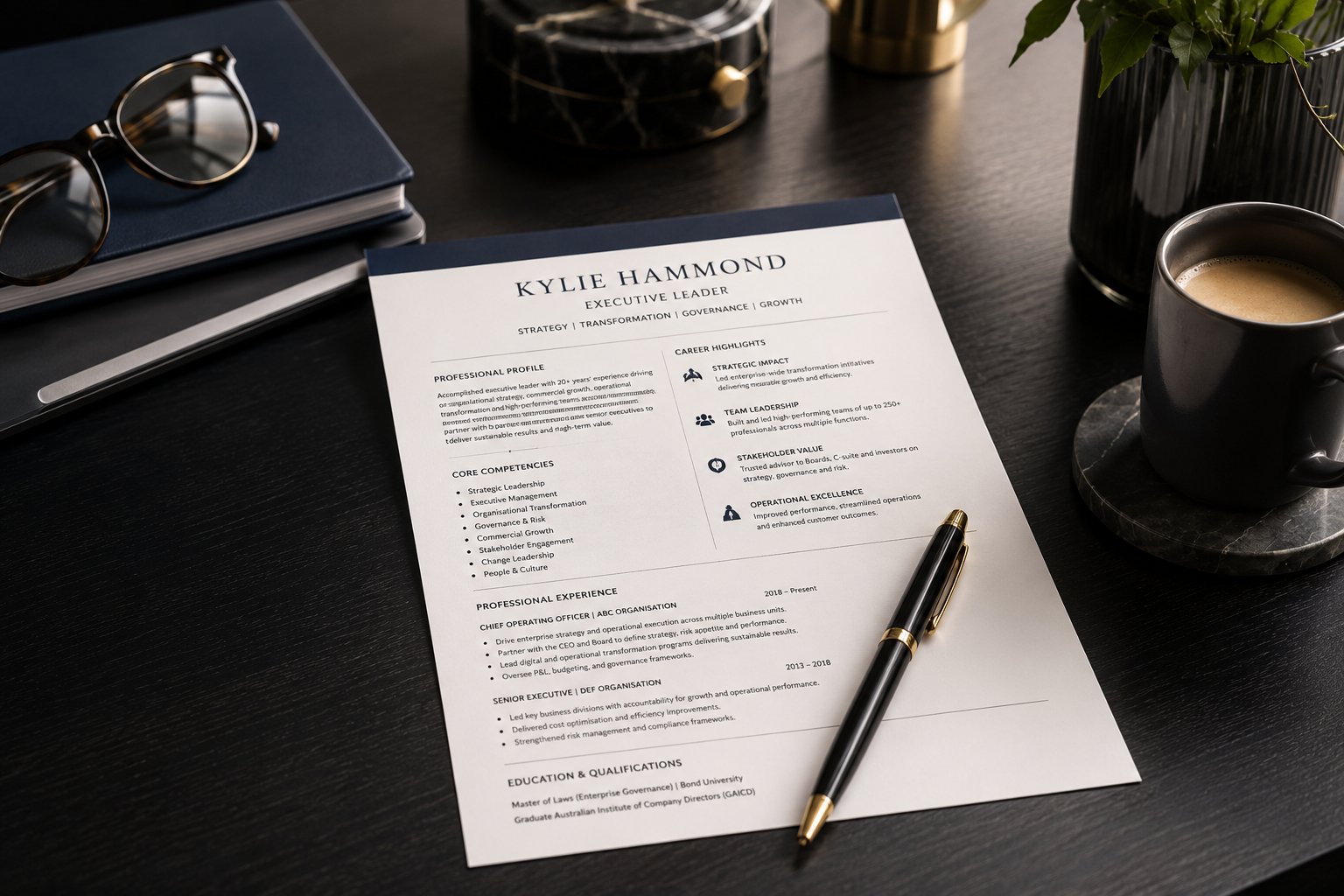
Most executive résumés are too long, too operational and too focused on what the person was responsible for. Responsibility matters, but it is not enough. A strong executive résumé tells the reader the level at which you operate, the scale you have led, the outcomes you have delivered and the problems you can solve again.
A good executive résumé should make it easy to see:
Do not try to make one document do every job. A CEO résumé, a functional C-suite résumé and a board résumé are different documents because the reader is assessing different things.

At executive level, LinkedIn is not simply an online CV. It is a discovery tool, a credibility check and often the first place somebody goes after your name has been mentioned in a room you were not in.
Your headline should say more than your current job title. Your About section should make your executive proposition clear. Your employment history should show scale, outcomes and relevant capability. Your contact information should make it possible for the right person to reach you. And your profile should broadly tell the same story as your résumé, biography and conversations with recruiters.
You do not need to become a full-time content creator. You do need a profile that supports the level at which you want to be considered.
A senior job search needs structure. Without it, people alternate between bursts of applications and long periods of waiting for recruiters to call. That is not a strategy.
Build your search around several channels at the same time:
Track the search. Know who you have spoken to, what was discussed, what the next action is and when you will follow up. Senior searches can take time, but “waiting” should never be the main activity.
Executive search firms are important, but they are not career agents. Their client is the hiring organisation. They will call when your background matches a mandate they are carrying.
That means your job is to make yourself easy to place in their mental database. Be specific about your level, target roles, sectors, geography, remuneration range and the situations where you add the most value. Keep your résumé current. Keep in touch when there is something useful to say. Do not send a generic “just checking in” email every fortnight.
And do not rely on recruiters alone. The strongest searches combine recruiter relationships with direct market intelligence and a strong senior network.
Strong executives often assume they will interview well because they are confident, articulate and know their subject. That is exactly why some under-prepare.
An executive interview is not a casual conversation. The panel is testing whether you can solve their problems, operate at the required scale, work with their stakeholders and fit the leadership environment. You need to prepare for that deliberately.

For Zoom and Teams interviews, treat the visual environment as part of the interview. Camera position, sound, lighting, eye line and interruptions matter. For panel and board interviews, practise directing the answer to the room rather than locking onto the person who asked the question.
After the interview, send a short, intelligent thank-you note. It should reinforce interest and, where useful, one or two points from the discussion. Do not send a miniature second cover letter.
Repeated interviews with no offer usually tell you something. It may be your examples. It may be that your answers are too long. You may be talking at the wrong altitude, underplaying commercial outcomes, failing to address the real concern in the room, or presenting as someone who wants the title rather than the problem.
Do not simply keep doing more interviews the same way. Get feedback where you can, debrief honestly, and change the preparation.
That is a different problem. The issue may be targeting, positioning, the résumé, LinkedIn, salary, location, sector assumptions, or the fact that you are relying too heavily on advertised roles. At senior level, a large volume of applications is not evidence of a strong search. Sometimes it is evidence that the search needs to be redesigned.
A senior redundancy can be commercially routine and personally confronting at the same time. The danger is either rushing into the first available role or disappearing from the market for too long while you work out what happened.
You need a clean narrative, current career materials, interview practice if you have not been in market for years, and a structured re-entry plan. If the exit was difficult, keep the explanation factual and short. The next employer is hiring your future value, not adjudicating the past.
For people who have been with one organisation for a long time, the practical work can be substantial: rebuilding recruiter relationships, learning how current interviews work, updating LinkedIn, translating internal titles into external market language and reconnecting with a network that may have gone quiet.
Not every career move requires leaving. Sometimes the better move is to reshape the role you already have.
If you want a promotion, broader remit or a remuneration review, make the business case before the conversation. Show the scope you are already carrying, the outcomes delivered, the responsibilities that have expanded, the market context and what the organisation gains by formalising the next step.
Internal career management is also about relationships. Who sees your work? Who advocates for you when you are not in the room? Are you known only inside your function, or across the enterprise? Senior progression is rarely decided by performance metrics alone.
For some senior executives, the right next chapter is not a single full-time role. It may be a mix of board positions, advisory roles, investment work, mentoring, consulting or a smaller executive commitment.
Do not wait until the day you retire to start building that market. Board and advisory careers take time because they rely heavily on reputation, positioning and relationships. If you think this may be part of the next three to five years, start building the foundations while your executive experience is current and visible.
Board Portfolio® · Tiger Boards
You do not need every service. Start with the problem you are trying to solve.

Meet Kylie
Kylie Hammond LLM Ent Gov is an executive search consultant, career mentor and founder of Tiger Boards. For more than 20 years she has worked with CEOs, C-suite executives and senior leaders on career decisions, positioning and the unadvertised market.
The advice on this page is the same advice she gives in the room: practical, specific, and aimed at the next useful step rather than a catalogue of services.
It can be when the issue is strategic rather than simply motivational: unclear positioning, a stalled search, an important transition, a promotion decision, a difficult exit or the need to access a market you do not know well. The value should be in better decisions, stronger positioning and a more effective search.
There is no reliable universal timeframe. Senior appointments can involve long processes, confidential searches and multiple stakeholders. The practical response is to run several channels at once and keep momentum rather than waiting on one opportunity.
Not automatically. A panic move can create a new positioning problem. Assess the role on its strategic value, scope, organisation, future options and whether the move makes sense as part of a coherent story.
Quality matters more than volume. Focus on consultants who genuinely recruit at your level and in your market, but do not make recruiter outreach your entire strategy.
Yes. Even when a role comes through a relationship, a current résumé is usually required somewhere in the process. It also forces clarity around your value proposition, scale and achievements.
Earlier than most people think. Board positioning and relationships take time. If a Board Portfolio® may be part of your medium-term plan, build the foundations while you are still current in the executive market.
If you are at a genuine career decision point and want an experienced view of the market, book a complimentary career assessment with Kylie Hammond. We can look at where you are now, what you are trying to achieve, the gaps in your current positioning and whether professional support would genuinely add value.
If you already know what you need, you can also review the career, résumé, interview and board services available through the site.